
Notes
In fact, the opposite is true: the most mystical, most religious, most wonderful—these are not less ordinary than most things—they are more ordinary than most things.
It is because they are so ordinary, indeed, that they strike to the core.
And this is connected to the fact that these things can, indeed, be expressed clearly, discovered, talked about.
These deep things which really matter, they are not fragile—they are so solid that they can be talked about, expressed quite clearly. What makes them hard to find is not that they are unusual, strange, hard to express—but on the contrary that they are so ordinary, so utterly basic in the ordinary bread and butter sense—that we never think of looking for them. Let me give two examples: one from the beauty of old prayer rugs, the other from the art of building.
The old Turkish prayer rugs, made two hundred years ago, have the most wonderful colors.
All of the good ones follow this rule: wherever there are two areas of color, side by side, there is a hairline of a different third color, between them. This rule is so simple to state. And yet the rugs which follow this rule have a brilliance, a dance of color. And the ones which do not follow it are somehow flat.
Of course this is not the only rule which makes a rug great—but this one rule, simple, banal, almost as it seems, will triple the brilliance and the beauty of a rug. A person who knows this rule may be able to make a beautiful rug. A person who does not will almost certainly not be able to.
And all the other features of the great old rugs also depend on other rather simple rules. But now most of these rules have been forgotten—and now they can no longer make the great rugs, with their glorious colors.
The depth, and spirituality, of the rug is not made less by the fact that this rule can be expressed, nor that it is so simple. What matters, simply, is that this rule is extremely deep, extremely powerful.
And the light in many glorious rooms is also governed by a simple rule.
Consider the simple rule that every room must have daylight on at least two sides (unless the room is less than 8 feet deep). This has the same character, exactly, as the rule about the colors. Rooms which follow this rule are pleasant to be in; rooms which do not follow it, with a few exceptions, are unpleasant to be in.

As the pattern languages die, everyone can see the chaos which emerges in our towns and buildings.
But the people do not know that it is the pattern languages which cause it. They know that buildings are less human than they used to be. They are willing to pay great prices for old buildings which were made at a time when people still knew how to make them human.
They complain bitterly about the lack of life, the danger, the merciless inhuman quality of their environment. But they do not know what to do about it.
In panic, people try to replace the lost order of the organic process, by artificial forms of order based on control.
Since the natural processes of building towns no longer work, in panic, people look for ways of “controlling” the design of towns and buildings. Those architects and planners who have become concerned by the insignificance of their influence on the environment make three kinds of efforts to gain “total design” control of the environment:
1. They try to control larger pieces of the environment (this is called urban design).
2. They try to control more pieces of the environment (this is called mass production or system-building).
3. They try to control the environment more firmly, by passing laws (this is called planning control).
But this makes things still worse.
These totalitarian efforts, although they do control more of the environment, have exactly the wrong effect.
They cannot create a whole environment, because they are not sufficiently responsive to the real needs, forces, demands, problems, of the people involved. Instead of making the environment more whole, they make it less whole.
At this stage, the pattern languages become still more fragmented, and more dead. They are controlled by even fewer people; they have even less of the living connection with the people which they need.
The variety, once created by organic and natural processes, disappears altogether.

In this view, it is the structure of the underlying language which is doing most of the hard work. If you want to influence the structure of your town, you must help to change the underlying languages. It is useless to be innovative in an individual building, or an individual plan, if this innovation does not become part of a living pattern language which everyone can use.
And we may conclude, even more strongly, that the central task of “architecture” is the creation of a single, shared, evolving, pattern language, which everyone contributes to, and everyone can use.

A living language must constantly be re-created in each person’s mind.
Even the ordinary language in a person’s mind (English, French, whatever) is created by him—it is not learned.
When a baby “learns” language from his parents, or from the people around him, he does not learn the rules which they have in their languages—because he cannot see or hear the rules. He only hears the sentences which they produce. What he does then, is to invent systems of rules, for himself, rules which are entirely invented, for the first time, by him. He keeps changing these rules, until with them, he can produce a language similar to the language he hears. And at that stage, we say that he has “learned” the language.
Of course, his rules are similar to his parents’ rules, because they have to generate approximately the same kinds of sentences. But in fact, the language he has “learned” is a system of rules, entirely created by him, in his own mind. And as he modifies his language, and improves it, deepens it, throughout his life—he does it, always, by creating, and improving rules, which he invents.
Just so with pattern languages.
Your mind has the innate capacity to create a pattern language. But its exact contents—the specific nature of the patterns in your language—is up to you. You must create them for yourself.
Since your experience is never exactly the same as anyone else’s, the versions of the patterns which you create are necessarily a little different from the versions that each other person finds out for himself.
This does not in any way deny the fact that there are objective, deep, invariant truths.
It merely means that each person will, when he finds out this truth for himself, wrest a slightly different version of this truth out for himself.
Then, as each person makes up his own language for himself, the language begins to be a living one.
And just as there will be variations from person to person, so too there will be even more noticeable variation from culture to culture.
The variation from person to person happens because different people actually do have, to some extent, different forces in themselves, and in their lives, and they will therefore experience different configurations of forces as life-giving, or life-destroying.

Of course, this evolution will never end.
Although the process of evolution will always move towards greater depth and greater wholeness, there is no end to it—there is no static perfect language, which, once defined, will stay defined forever. No language is ever finished.
The reason is this. Each language specifies a certain structure for some environment. Once realized, in practice, the very existence of that structure will create new forces, which are born for the first time, out of that structure—and these new forces will, of course, create new problems, new conflicts, that need to be resolved by new patterns—which, when added to our languages, will create still newer forces once again.
This is the eternal cycle of development. There is no hope of stilling it, and no need either. We must simply accept the fact that in the process of evolution, there is no final equilibrium. There are passing phases which approach equilibrium—but that is all. The search for equilibrium, the brush in the dark with a moment of stability, the wave which hesitates a moment before it crashes into the sea again—that is the closest constancy will ever come to being satisfied.

And, above all, it is not just a passive picture. It has power in it. It is a language, active, powerful, which has the power to let men transform themselves, and their surroundings.
Imagine that one day millions of people are using pattern languages, and making them again. Won’t it impress itself then, as extraordinary, that these poems which they exchange, this giant tapestry of images, which they create, is coming alive before their eyes. Will it be possible then, for people to say stonily, that poems are not real, and that patterns are nothing but images: when, in fact, the world of images controls the world of matter.

No building is ever perfect.
Each building, when it is first built, is an attempt to make a self-maintaining whole configuration.
But our predictions are invariably wrong. People use buildings differently from the way they thought they would. And the larger the pieces become, the more serious this is.
The process of design, in the mind’s eye, or on the site, is an attempt to simulate in advance, the feeling and events which will emerge in the real building, and to create a configuration which is in repose with respect to these events.
But the prediction is all guesswork; the real events which happen there are always at least slightly different; and the larger the building is, the more likely the guesses are to be inaccurate.

In a town or building which is whole, there are no places like this; and in a life which is truly lived, there are no moments like this either.
In a life which is truly lived, there are no moments which are “in between” or “out of life”—every moment is lived fully. The Zen master says “when I eat, I eat; when I drink, I drink; when I walk, I walk.” A building or a town which is alive, has the same quality.
In a building or a town which is alive, and which supports a life that is fully lived, there are no places which are way-stations between moments of living; every place is made in such a way that life can be savored fully there.
Every square inch of it has some valuable purpose, and is able to support some moment in a person’s life which is truly lived; and for this reason every part of it is whole, and every place between two wholes is also whole.
This goes vastly beyond the normal conception of repair.
In the commonplace use of the word repair, we assume that when we repair something, we are essentially trying to get it back to its original state. This kind of repair is patching, conservative, static.
But in this new use of the word repair, we assume, instead, that every entity is changing constantly: and that at every moment we use the defects of the present state as the starting point for the definition of the new state.
When we repair something in this new sense, we assume that we are going to transform it, that new wholes will be born, that, indeed, the entire whole which is being repaired will become a different whole as the result of the repair.
In this sense, the idea of repair is creative, dynamic, open.
It assumes that we are constantly led to the creation of new wholes, by paying attention to the defects in the existing wholes, and trying to repair them. It is still true that every act helps to repair some larger, older whole: but the repair not only patches it—it also modifies it, transforms it, sets it on the road to becoming something else, entirely new.

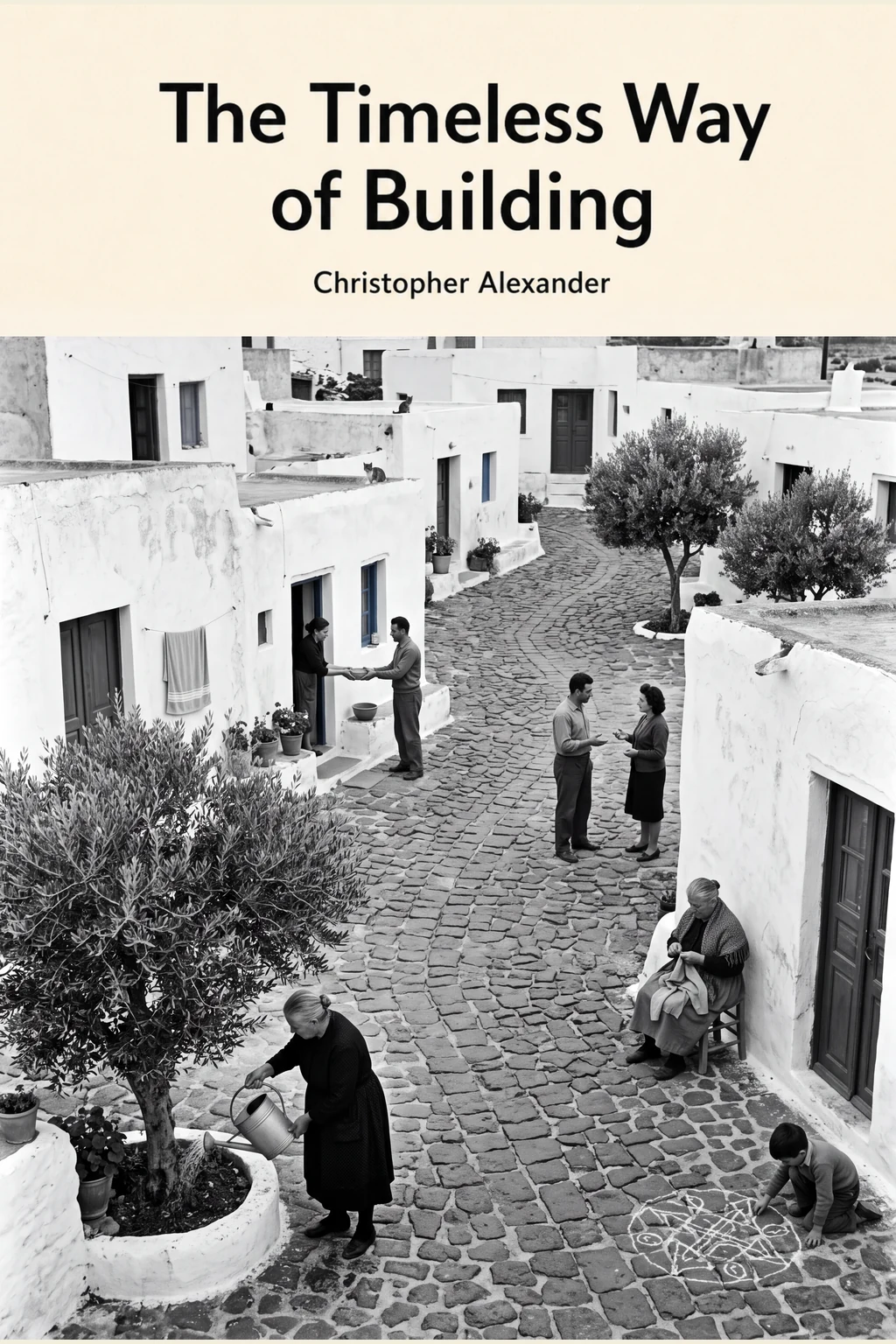
At one time people believed that a town had to be planned by a planner who made a plan or blueprint. It was said that if the order of the town is not created from above, there will just not be an order in the town. And so, even in spite of the most obvious evidence of all the beautiful towns and villages built in traditional societies without master plans, this belief has taken hold, and people have allowed themselves to give up their freedom.
As in biology, though, it is becoming clear now that the structure of a town can be woven much more deeply, more intricately, from the interaction of its individual acts of building within a common language, than it can from a blueprint or a master plan—and that indeed, just like your hand, or like the bush outside my window, it is best generated by the interaction of the rules which govern the construction of the parts.
